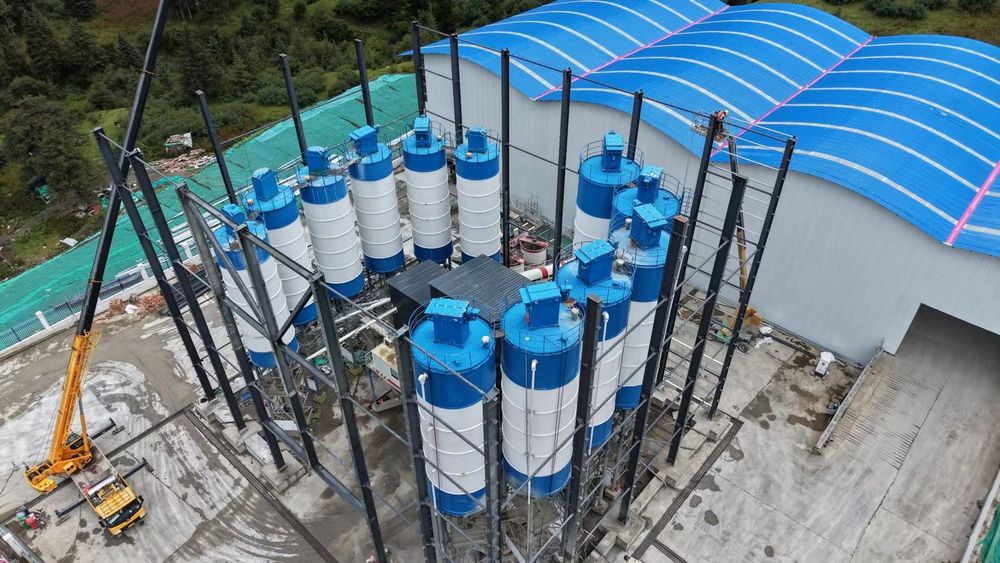
Real project photos can reduce purchasing risk, but only when buyers read them as technical evidence rather than decoration. A wide-angle image may prove that equipment reached a site; it does not by itself prove the quoted capacity, batching accuracy or long-term reliability. The useful question is: what specific part of the proposed configuration can this image verify?
Mikkino groups field material in a concrete batching plant project photo gallery and connects selected images to detailed cases, including the ready-mix plant drone project, Nigeria HZS150 double-line plant and Indonesia HZS180 project.
Start with traceability, not appearance
Ask the supplier to identify the country, plant type, approximate commissioning period and the modules visible in each reference. A useful photo set should include an overall view, aggregate feeding, mixer tower, powder storage, discharge position and control area. If the same isolated image is used to support several unrelated models, ask for a model-specific explanation.
Read the full material flow
A drone or elevated photo should let you trace aggregate from stockpile or loader route to the batching machine, then through the belt or skip system to the mixer. Powder should be traceable from silo through screw conveyor to the weighing system. Finally, check the path from mixer discharge to the truck or receiving hopper. Missing links in this flow often identify the questions that must be answered in the layout drawing.
Compare the project with your site
Do not copy a reference layout without checking land dimensions and traffic. Record the truck entry and exit direction, loader turning area, distance between aggregate storage and bins, silo-filling access, drainage route and room for future expansion. A plant can be mechanically complete and still lose output because trucks reverse under the discharge point or the loader crosses the delivery route.
Look for maintainability
Close-up images should show platforms, stairs, guardrails, access doors, lubrication points and clearance around motors, reducers and screw conveyors. Confirm that mixer liners, arms and seals can be reached without dismantling unrelated structures. Maintenance access does not guarantee good maintenance, but poor access makes delayed inspection and longer downtime more likely.
Match photos to the bill of equipment
The same HZS120 or HZS180 label can hide different mixer sizes, aggregate compartments, silo quantities, belt widths and control arrangements. Put the quotation beside the photo set and mark each major item as visible, explained by a drawing or still unverified. This prevents a proven large project from being used as evidence for a lower-specification offer.
- Mixer model and compacted output per batch.
- Aggregate bin quantity, weighing method and feeding system.
- Cement, fly ash or additive storage and corresponding screw conveyors.
- Truck loading height, route and expected dispatch interval.
- Control-room arrangement, laboratory interface and operator visibility.
Separate visual evidence from performance evidence
Photos can verify physical configuration and installation quality. They cannot verify hourly net output, weighing tolerance or concrete strength. For those claims, request commissioning records, calibration results, batch reports or an agreed acceptance test. A reported 70% operating level can be a conservative planning reference during early production, but it is not a universal guarantee; loader speed, recipe, operator experience, truck dispatch and site conditions all change the result.
Use a repeatable project-photo review
- Confirm that the project type and capacity class are relevant to your demand.
- Trace material, vehicle and maintenance flows on the overall view.
- Compare visible modules with the quotation and layout drawing.
- List claims that need records rather than photos.
- Send your site plan and ask what must change for local conditions.
Quotation checklist for buyers
- Required capacity: 35, 50, 60, 90, 120, 180 m3/h or custom demand.
- Plant use: ready-mix sales, road project, bridge, building site, precast or internal construction.
- Preferred type: stationary concrete batching plant, mobile concrete batching plant or foundation-free plant.
- Destination country, nearest port, local voltage and expected installation schedule.
- Site photos, land size, aggregate storage plan and truck access direction.
Common questions
Can a supplier protect customer privacy and still provide evidence? Yes. Commercial names and exact locations may be withheld while the supplier explains the equipment class, application and visible configuration.
Should photos replace a factory inspection? No. They are one layer of due diligence. For a high-value order, combine reference material with technical documents, video inspection or an on-site visit where practical.
Can Mikkino review a buyer's site photos? Yes. Send dimensions, access direction, elevation difference and capacity target through the quotation form. The project proof library provides comparison evidence; the final layout must still be designed for the actual site.